August 26, 2026
HazCom Deadline 2026: 3 Employer Requirements You Can’t Afford to Miss

August 26, 2026
If your organization works with hazardous chemicals, you’ve probably heard about the November 2026 compliance date more than once this year. It’s come up in conversations about new hire onboarding, emergency planning, and safety program audits. This time it isn’t a footnote. The HazCom deadline is now less than three months out, and for employers working with pure hazardous substances, there are three specific requirements that need to be complete by then.
This article breaks down what OSHA actually requires, how to tell whether that date applies to your organization at all, and what each of the three requirements involves in practice. Not every employer is on the same timeline, and knowing which one you’re on is the first step.
OSHA’s revised Hazard Communication Standard aligns the rule more closely with the seventh revision of the Globally Harmonized System. The practical effect for employers is that hazard classifications, label elements, and safety data sheet content have all been updated, which means documents and training built around the previous version may no longer reflect current requirements.
The compliance schedule was built in stages. Chemical manufacturers, importers, and distributors had an earlier date in May 2026 to bring pure substances into alignment with the revised standard. That date has passed, which means updated safety data sheets and labels should already be arriving with your shipments.
If you haven’t reviewed what’s coming in from your suppliers recently, that’s worth doing before the employer HazCom requirements come due. The documents your suppliers send are the raw material for everything the HazCom deadline asks employers to produce.
Here’s the part most coverage skips entirely, and it matters enormously: not every employer is working against the same date. The revised standard sets separate compliance dates for pure substances and for mixtures, and applying the wrong one to your organization means either scrambling unnecessarily or missing a requirement you actually have.
Look at your safety data sheets. Does the SDS cover a single chemical compound, identified by one CAS number? That’s a substance, and the November 2026 date applies. Does it cover a formulated product that combines multiple chemicals? That’s a mixture, and the employer compliance date is in May 2028.
| Category | What It Is | Common Examples | Employer Date |
|---|---|---|---|
| Pure Substances | Single chemical compounds, one CAS number | Acetone, benzene, ammonia, chlorine, sulfuric acid, methanol, toluene | November 20, 2026 |
| Mixtures | Formulated products combining multiple substances | Paints, adhesives, cleaning products, lubricants, cutting fluids, degreasers | May 19, 2028 |
Most facilities handle both, which usually means the November HazCom deadline applies to part of your chemical inventory now and the rest follows later. If your inventory includes any pure substances at all, that date is live for those materials today.
One note worth stating plainly: Atlantic Training provides the training. We do not make compliance determinations for your facility. If you’re uncertain how the standard applies to a specific chemical or process, the standard itself and a qualified EHS professional are the right places to go.
For employers with pure substances in their inventory, the revised standard sets out three distinct obligations. All three must be complete, and finishing two of them does not partially satisfy the third.
Every alternative workplace container label needs to reflect the GHS-aligned format under the revised standard. This covers the secondary containers your employees actually interact with day to day: the transfer bottles, the process vessels, the spray containers filled from a bulk drum. Shipped container labels come from your supplier. Workplace labels are your responsibility.
This is often the most labor-intensive of the three requirements simply because of volume. A facility with hundreds of secondary containers has hundreds of labels to review. Our Hazard Communication: GHS Labeling Requirements course covers the current label elements in detail, and our Container Labeling, Transportation and Storage course extends that into how labeled containers should be handled and stored once they leave the fill station.
Your written program has to reflect the revised standard, not the version it was written against. In practice that means reviewing your chemical inventory list, your safety data sheet management procedures, your labeling protocols, and the documentation that ties them together. This is the prong that tends to sit with one person, which is exactly why it stalls.
Safety data sheets deserve particular attention here, because the revised standard changed SDS content requirements. A written program that describes how employees access and interpret safety data sheets should describe the current format, not the previous one. Our Hazard Communication: GHS Safety Data Sheets course walks through the updated SDS structure section by section, which is useful both for the employees who read them and for whoever is updating the written program that governs them.
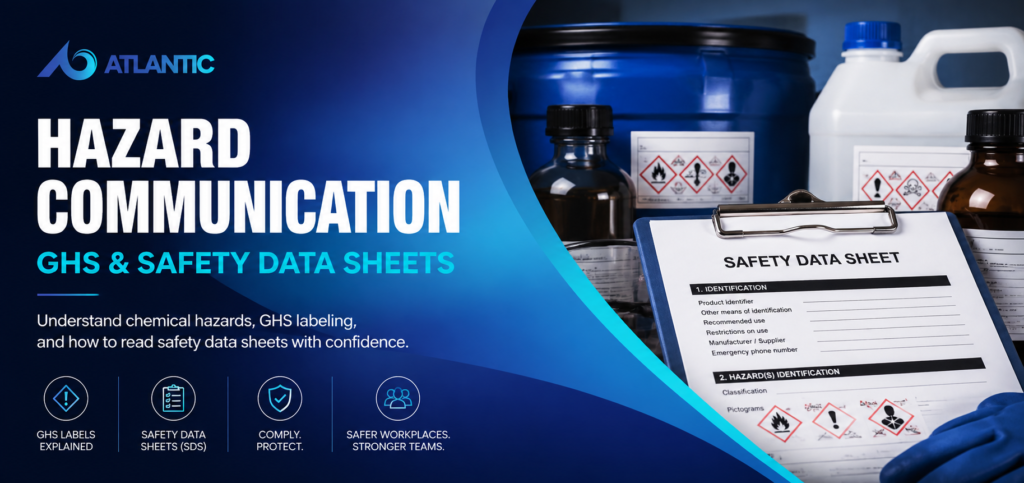
The third requirement is the one that most often gets deferred, and it’s the one where the HazCom deadline creates the most exposure. Training must reflect the updated GHS hazard classifications and communication requirements under the revised standard. Training built around the previous version doesn’t satisfy the requirement, even if it was thorough when it was delivered.
There’s a distinction worth drawing out here. Purchasing updated training and completing updated training are not the same thing. Training is only good if it’s assigned and taken. A course sitting unassigned in a library on November 20 does nothing for your compliance position, and it does nothing for the employee who’s still working from outdated hazard information.
Atlantic Training’s 2026 HazCom courses cover the updated classifications under the revised standard. Our flagship HAZCOM: In The Know course is the general-workforce starting point, covering the current hazard classes, label elements, and how employees should use the information available to them. For facilities where chemical handling carries spill risk, our Hazardous Materials: Hazard Communication and Spill Containment course connects hazard communication to the response side of the same problem.
These requirements are easier to complete as one project than as three. The chemical inventory review that feeds your written program update is the same review that tells you which workplace labels need attention. The updated classifications that drive your labeling work are the same ones your training needs to cover. Organizations that treat the HazCom deadline as a single coordinated effort tend to finish. Organizations that treat it as three separate tasks tend to finish two.
Less than three months is enough time to do this well, but not enough time to start late. Our free HazCom GHS Employer Compliance Guide walks through all three requirements, includes the substances and mixtures reference so you can confirm which date applies to your inventory, and gives you a structure for working through the labeling, program, and training prongs together rather than sequentially. Download your free copy here.
The regulation is public, the date is fixed, and the requirements are specific. What varies between organizations is whether the work started in September or in November. Grab the guide, confirm which HazCom deadline applies to you, and get the training assigned while there’s still runway. You can browse the full Atlantic Training course catalog to build out the rest of your program, and our Resource Hub has free downloadable guides and checklists across every major safety topic. Get the free compliance guide here.